A Crisis Averted
A last-minute artifact needed cleaned — but properly.
As archivist for the Felician Sisters of North America, I knew I would run into some interesting objects when I took this position. I've been trained and prepared to properly manage and care for many things a person in my position would expect to encounter, but, somehow, I never imagined I would need to know how to clean a statue made of fiberglass. What an oddly specific substrate.
So, when a member of the staff setting up our new Heritage Center came to me with this fiberglass bas-relief that was covered in dirt and moss, I politely said "thank you, but no" when a nearby contractor kindly offered to use his pressure washer to clean it!
As the opening celebration was less than a week away and this last-minute piece needed to be hung on a wall, ready for public viewing, I had to act fast.
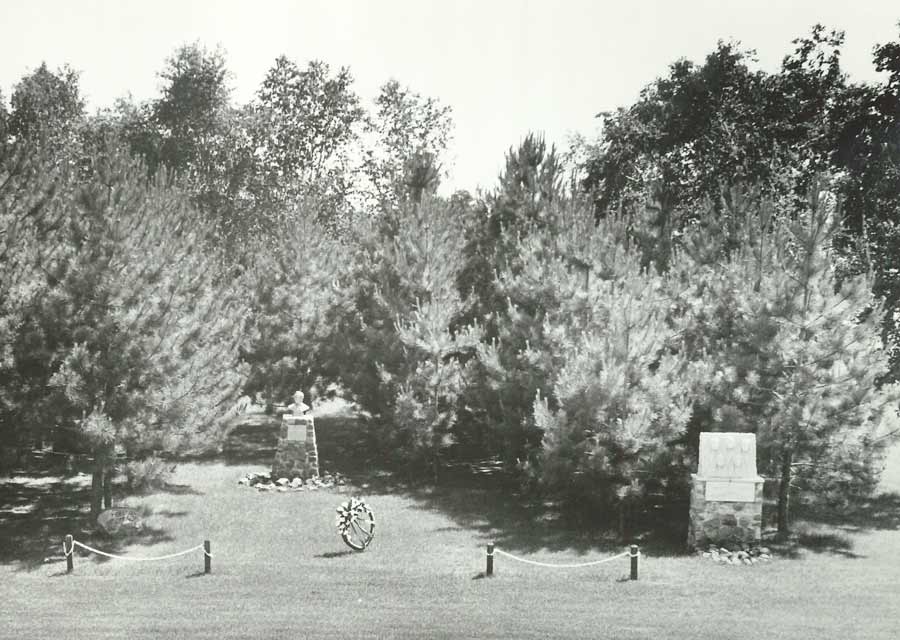
On the grounds of the first convent in Polonia, Wisconsin, a memorial to Father Joseph Dabrowski is to the left and the memorial to the five sisters is to the right.
The Story of the Piece
How did it come to be?
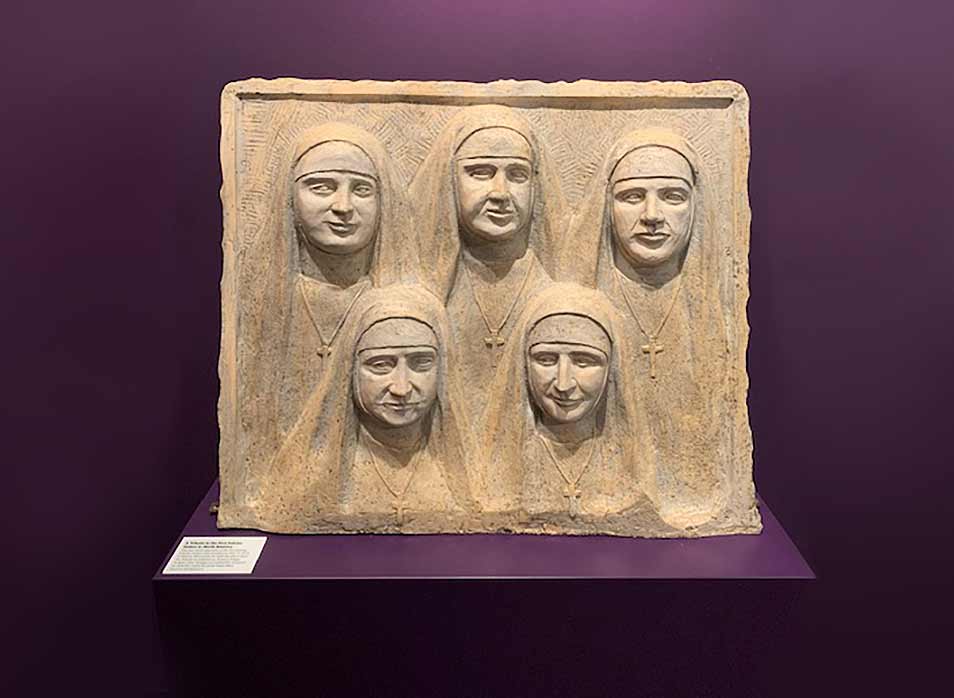
The statue in question is titled, A Tribute to the First Felician Sisters in North America. It's a bas-relief depiction of the five pioneer Felician Sisters who arrived from Poland and founded the Felician mission in North America back in 1874. The sisters featured are Mother Mary Monica Sybilska, Mother Mary Cajetan Jankiewicz, Sister Mary Wenceslaus Zubrzycka, Sister Mary Vincentine Kalwa, and Sister Mary Raphael Sworzeniowska.
Made entirely of fiberglass with a bit of white paint on the front, the “relief” is actually not that old. It was only just created in the 1970s by sculptor Gino Testaguzza, a retired sculptor from Oxford, Michigan.
The story goes that on a visit to St. Clare Convent in Polonia, Superior General Mother Mary Amadeus Lewicka remarked that it was unfortunate there was no memorial there to honor the pioneer Felicians. Most likely this was because there is a statue of Father Joseph Dabrowski, who requested the sisters come there from Poland. To remedy this concern for Mother Amadeus, Sister Mary Pontia Kapanowski began to inquire at various statuary companies to see what could be done. It was she who engaged Gino Testaguzza.
Gino Testaguzzo came up with the idea to make the sculpture a "bas-relief" out of fiberglass. That is, a sculpture raised out of a flat background. But why he chose fiberglass is unknown to me, so far.
Sister Pontia agreed, but insisted that the pioneer sisters had to resemble their younger selves when they first came to America in 1874, and not their photographs taken much later. She enlisted artist Sister Mary Stanisia (Lottie) Hindelewicz from Mother of Good Counsel Province to create a sketch that Gino Testaguzza could use to do his sculpting work.
To Mother Amadeus’ satisfaction, the artwork was unveiled on May 27, 1979, in Polonia, Wisconsin, in conjunction with the 105th anniversary of the sisters’ arrival in America.
There, the statue stood in the Memorial Grove on the grounds of Saint Clare Convent in Polonia for the better part of four decades. Over that long time, it accumulated moss, dirt, bugs, and bird droppings, and was affected by erosion caused by the elements. It needed some TLC.
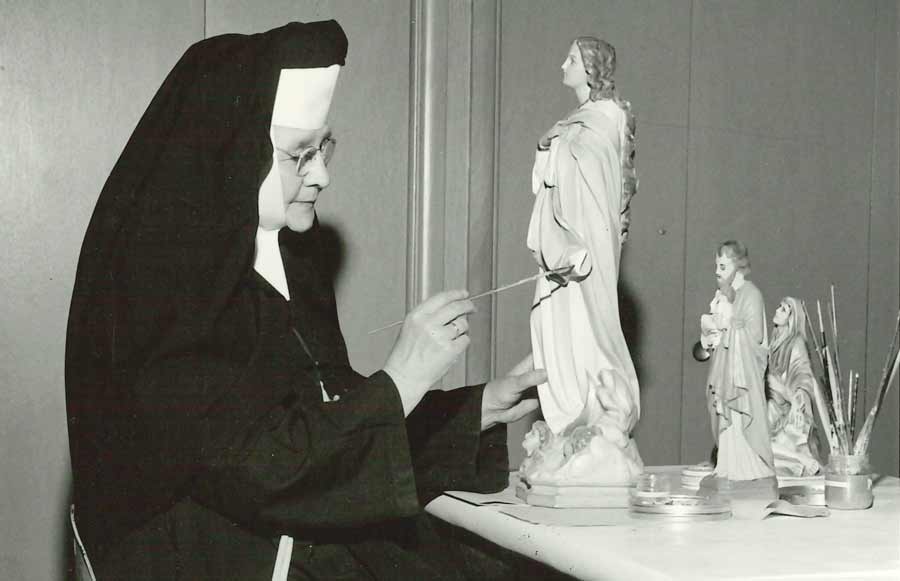
Below: The artist Felician Sister Stanisia Hindelwicz painting statues.
How to Clean Fiberglass
Gently, and on a budget.
Believe it or not, they don't teach you how to clean fiberglass statues in archive school. This was a very unique choice of substrate. But I did research to learn what would clean, and not deteriorate the surface of this art piece, already so compromised by nearly 46 years of enduring weather extremes.
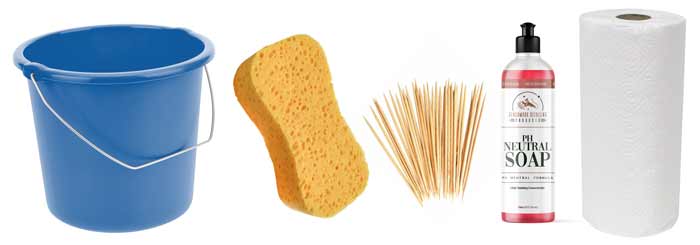
The materials needed were very budget-friendly:
- Bucket - For water and soap (we actually bought this bucket to hold a cleaning solution for the vinyl records in the archive's collection, but this project came first.)
- Paper towels - To wipe up all the soap and water, and dirt that inevitably gets all over.
- Soap - Gentle soap with a near-neutral pH.
- Sponge - To generally and gently apply the soap and water.
- Toothpicks - To get into those hard-to-reach crevasses, but not scratch into the surface.
Slow, and With Care
This type of work should not be rushed.
Are you wondering how long it took me to properly clean this 27.25" x 34" x 13.5" piece by hand?
It took two days.
I worked most of the Friday, and all of the Monday before the Heritage Center opened readying the piece to be mounted.
Was my method perfect?
No.
Is it completely clean?
No.
Is the statue better than what it was?
Definitely.
While my methods were not as immediate as a power washer, more gentle care is required for the life of a historic piece like this.
And it's important to accept that to clean this statue perfectly is just not possible. There was no way to undo damage caused by erosion or remove stains, dirt, and bird poop from corners without digging into the fiberglass and causing further harm. We wanted the sisters’ faces to be clean enough to see, but I refrained from getting carried away, which might have led to chipping off parts of their faces.
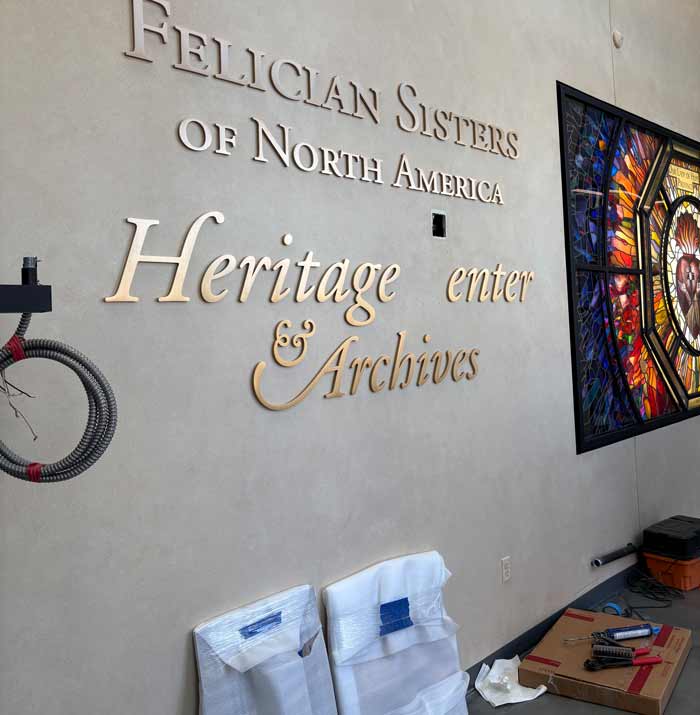
Part of the hallway outside of the Heritage Center as workers finished up.
...On the Floor
This artwork required that I come to it.
You might imagine this work was performed in a clean lab room on a metal table.
Actually, it had to be done right on the hallway floor outside of the Heritage Center.
The statue was too heavy and obtuse to put on a table and maneuver this way and that, nor could I transport it down to the basement, where the archive is located, which is where my work is mainly done. Besides, we had just set up the archive space with exhibits for the tours that would be visiting during the 150th celebration.
So, there I sat while contractors moved around me to put the finishing touches on the Heritage Center. Cleaning away, my feet and legs needed to constantly readjust to prevent them from falling asleep.
This work put me physically in the center of excitement during the preparations for the opening. I turned on an audiobook and got hyper-focused on getting it done.
The finished bas-relief on its pedestal in the exit area of the Heritage Center. The five Felician pioneers smiles will be one of the last pieces you’ll see when you visit.
Lights, Camera, Action!
The culmination of years, and final moments of work were finally on display.
I cleaned until the last possible moment before the contractors had to install the statue on its pedestal in the Heritage Center.
Though the statue was getting cleaner and cleaner, there were little spots in the crevasses that kept catching my eye. Some I was able to eliminate, some were stains that are here to stay, and some I had to give up on or I might have ended up eliminating Mother Mary Monica’s nose if I persisted. That's where I was in my progress when the general contractor said, “Put down your toothpicks!” Time was up.
I patted down the statue with a paper towel, and two men lifted it to its pedestal of grandeur. It was judgment time.
Then, Friday, November 21st, 2025, came and went.
But the verdict on A Tribute to the First Felician Sisters in North America was fantastic, as was the rest of the Heritage Center! Everyone loved reading about and seeing this piece with the pioneer sisters’ faces restored as close to the original condition as I was capable of in my short window of time.
Being able to clean this statue and see how it looks under professional museum-grade lighting made me proud to have been a part of putting the center together. As an archivist for the Felician Sisters, I know I helped behind the scenes by gathering lots of pictures and artifacts and digging through boxes and documents to fact-check and find more content for some stories... but cleaning this statue was a hands-on experience that made this contribution feel more real and more earned.
If you would like to see A Tribute to the First Felician Sisters in North America in person, or other objects in the Heritage Center that I helped find and verify, you can schedule an appointment to visit.
If you are inspired by the work they've done for 150 years in North America and would like to support the Felician Sisters of North America in continuing their work, visit Felician.org/Donate.